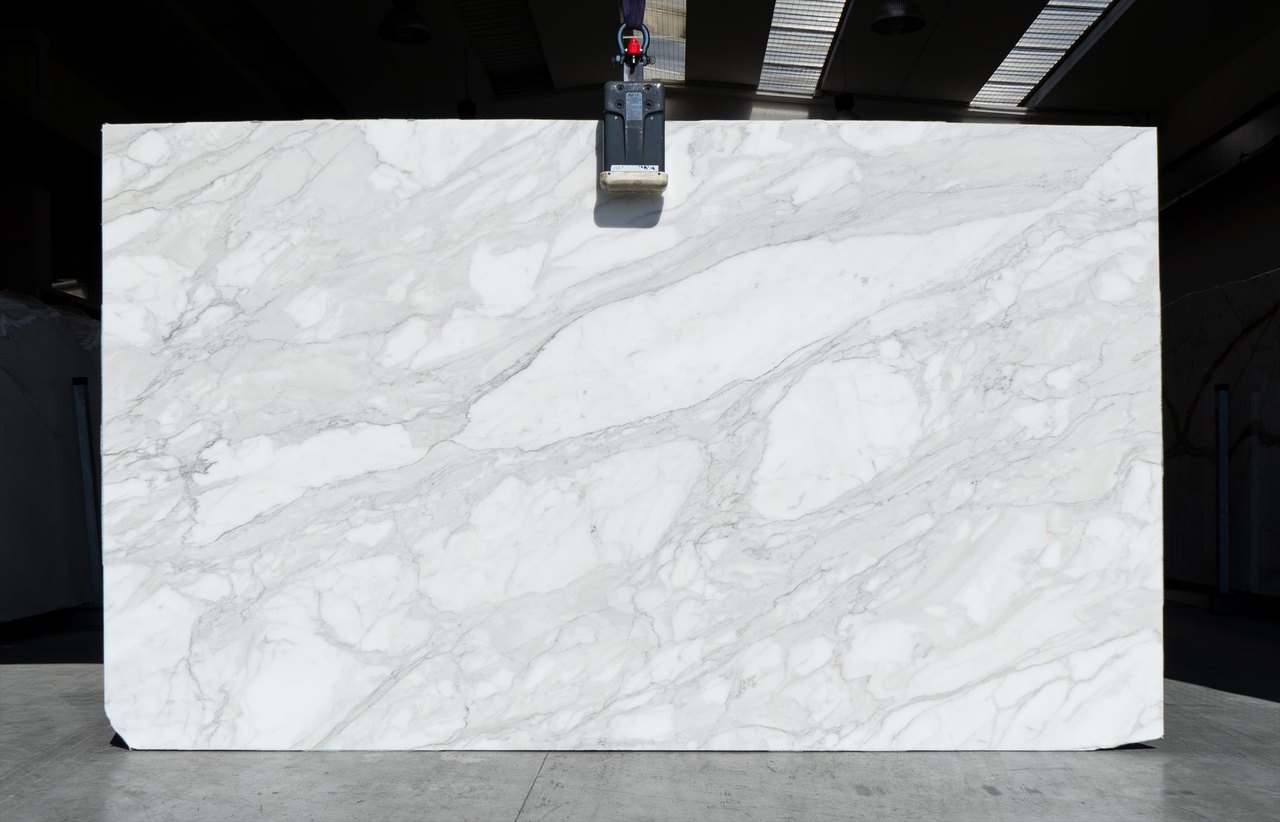
Granite, quartzite, and marble — one of a kind, by definition.
Every slab is one of a kind. Browse photos of real slabs, save your favorites, and bring your list to the showroom.
Every slab is one of a kind, so no two kitchens with the same stone name look alike. Choosing used to mean driving to a warehouse to see what was on the rack. Now you can browse photos of real slabs at MSI's Seattle warehouse and Cosentino's Spokane warehouse (the list is updated monthly), save the ones you like, and walk into the showroom already knowing your favorites.
In a hurry? The stones and their slab photos are further down this page.
A two-inch chip can't tell you where the veining runs or how it lands on your island. Start with the actual slab photos below, with bundle numbers (the warehouse's ID for a set of matching slabs) and square footage. Then we'll set up a slab walk, a visit to see your actual slabs, so you're standing in front of your favorites before anything is cut.
What we source, and what it asks of you.
Granite — hard, heat-tolerant, enormous range from quiet speckle to dramatic movement. Quartzite — the marble look with far better durability; our usual answer for people who love marble and cook seriously. Marble — unmatched for beauty, and it will patina; we'll be honest with you about that before you commit.
Granite, quartzite and marble want sealing: once at install and about once a year after, which takes about ten minutes with a bottle from the hardware store. Sensa is the exception. Cosentino treats Sensa stone at the factory to resist stains and warrants that treatment for 15 years, so don't put other sealers on it. If sealing sounds like a chore, quartz or Sensa is the better fit, and we'll say so.
Cut, profiled and polished in our own shop.
Natural stone is unforgiving — every slab is a one-off, and once it is cut there is no second copy. We template your room, lay out the cuts against your slab so the veining lands where you want it, and profile and polish every edge ourselves. Nothing about your top is handed to a subcontractor and hoped for.
Granite, quartzite and marble are one of a kind, so we don't show a generic catalog. Below are photos of actual slabs at MSI's Seattle warehouse and Cosentino's Spokane warehouse, updated monthly. Sensa and Scalea are Cosentino's natural stone lines; Sensa comes with a factory stain treatment. Filter by color, stone or feeling, and tap any slab to see it closer.
154 with slabs in stock
Color
Stone
Feeling
Program
Nothing matches those filters. Clear one, or ask us. We can often get what you're after even if it isn't shown.
Tap the + on any stone, or “Save to my list” on a slab, to add it to My list. My list comes with you to the consultation form, so there's no retyping. “Ask about this stone” saves it and opens the form; nothing is sent until you send the form.
Stones marked “Actual slabs · Seattle” include photos of the bundles on the rack at MSI's Seattle warehouse. Tap one and the slab photos you see are slabs we can order. The list is updated monthly.
Cosentino stones (Sensa and Scalea) marked “Actual slabs · Spokane” work the same way. Each photo is one specific slab at Cosentino's Spokane warehouse, listed by thickness with its lot number (Cosentino's ID for that one slab) and measurements.
Slab inventory moves. If a stone here is gone by the time you call, we'll track down its closest neighbor — or something better. Availability is confirmed before ordering.
View the complete natural stone list (176 stones)
Absolute Black — MSI (granite)
African Rainbow — MSI (granite)
Agatha Black — MSI (granite)
Alpine Valley — MSI (granite)
Amarello Ornamental — MSI (granite)
Andino White — MSI (granite)
Aspen White — MSI (granite)
Astoria — MSI (granite)
Avalon White — MSI (granite)
Azul Celeste — MSI (granite)
Azul Platino — MSI (granite)
Bianco Antico — MSI (granite)
Bianco Frost — MSI (granite)
Black Galaxy — MSI (granite)
Black Pearl — MSI (granite)
Caledonia — MSI (granite)
Caravelas Gold — MSI (granite)
Ceara White — MSI (granite)
Colonial Cream — MSI (granite)
Colonial White — MSI (granite)
Crema Atlantico — MSI (granite)
Crema Caramel — MSI (granite)
Delicatus White — MSI (granite)
Desert Beach — MSI (granite)
Eclipse — MSI (granite)
Gray Mist — MSI (granite)
Gray Nuevo — MSI (granite)
Himalaya White — MSI (granite)
Lennon — MSI (granite)
Mirage White — MSI (granite)
New River White — MSI (granite)
Oyster White — MSI (granite)
Patagonia — MSI (granite)
Pitaya White — MSI (granite)
Premium Black — MSI (granite)
S F Real — MSI (granite)
Salinas White — MSI (granite)
Silver Cloud — MSI (granite)
Silver Falls — MSI (granite)
Silver Waves — MSI (granite)
Steel Grey — MSI (granite)
Stream White — MSI (granite)
Sunset Canyon — MSI (granite)
Titanium — MSI (granite)
Typhoon Bordeaux — MSI (granite)
Ubatuba — MSI (granite)
Valle Nevado — MSI (granite)
Virginia Mist — MSI (granite)
White Ice — MSI (granite)
White Napoli — MSI (granite)
White Ornamental — MSI (granite)
White Sparkle — MSI (granite)
White Spring — MSI (granite)
White Valley — MSI (granite)
White Wave — MSI (granite)
Absolute White — MSI (marble)
Arabescus White — MSI (marble)
Calacatta Marble — MSI (marble)
Carrara White — MSI (marble)
Fantasy Brown — MSI (marble)
Fantasy River — MSI (marble)
Portinari Marble — MSI (marble)
Super White — MSI (marble)
Acquatic — MSI (quartzite)
Allure — MSI (quartzite)
Andes Black — MSI (quartzite)
Audacia — MSI (quartzite)
Azul Imperiale — MSI (quartzite)
Azul Treasure — MSI (quartzite)
Belvedere — MSI (quartzite)
Blue Fusion — MSI (quartzite)
Blue Lava — MSI (quartzite)
Blue Roma — MSI (quartzite)
Calacatta Macaubas — MSI (quartzite)
Calacatta Montreal — MSI (quartzite)
Cirrus Gray — MSI (quartzite)
Cristallo — MSI (quartzite)
Denali — MSI (quartzite)
Fantasy Macaubas — MSI (quartzite)
Fantasy Montreal — MSI (quartzite)
Florida Wave — MSI (quartzite)
Glacier Wave — MSI (quartzite)
Infinity Black — MSI (quartzite)
Kalahari — MSI (quartzite)
Madreperola — MSI (quartzite)
Mercury Gray — MSI (quartzite)
Milano — MSI (quartzite)
Platinum Black — MSI (quartzite)
Platinum Blue — MSI (quartzite)
Taj Mahal — MSI (quartzite)
Tempest — MSI (quartzite)
White Macaubas — MSI (quartzite)
Black Soapstone — MSI (soapstone)
San Benedito 3cm (1¼″) — Sensa (granite)
Thailand 3cm (1¼″) — Sensa (granite)
Tanami 3cm (1¼″) — Sensa (granite)
Iberian Sunset 3cm (1¼″) — Sensa (granite)
Blue Jeans 3cm (1¼″) — Sensa (granite)
Platino 3cm (1¼″) — Sensa (quartzite)
Crescent Veil 2cm (¾″) — Sensa (granite)
White Macaubas 3cm (1¼″) — Sensa (quartzite)
Cristalo 3cm (1¼″) — Sensa (quartzite)
Juparana Cathedral 3cm (1¼″) — Sensa (granite)
Crema Pearl 3cm (1¼″) — Sensa (granite)
Oihana 3cm (1¼″) — Sensa (quartzite)
Madeira 3cm (1¼″) — Sensa (quartzite)
Nilo 3cm (1¼″) — Sensa (quartzite)
Delicatus Ice 3cm (1¼″) — Sensa (granite)
Tangier 3cm (1¼″) — Sensa (granite)
Nahoa 3cm (1¼″) — Sensa (quartzite)
New Caledonia 3cm (1¼″) — Sensa (granite)
White Napoli 3cm (1¼″) — Sensa (granite)
Amelia Ridge 3cm (1¼″) — Sensa (granite)
Kaira 3cm (1¼″) — Sensa (quartzite)
Argenti Grey 3cm (1¼″) — Sensa (granite)
Graphite Grey 3cm (1¼″) — Sensa (granite)
White Alamo 3cm (1¼″) — Sensa (granite)
Naori 3cm (1¼″) — Sensa (granite)
Orinoco 3cm (1¼″) — Sensa (granite)
Blanco Gabriele 3cm (1¼″) — Sensa (granite)
Marau 3cm (1¼″) — Sensa (quartzite)
San Benedito 2cm (¾″) — Sensa (granite)
Itara 3cm (1¼″) — Sensa (quartzite)
White Egeo 3cm (1¼″) — Sensa (granite)
Smoky White 3cm (1¼″) — Sensa (granite)
Via Lattea 3cm (1¼″) — Sensa (granite)
Snowfall 3cm (1¼″) — Sensa (granite)
Graphite Grey 3cm (1¼″) — Sensa (granite)
San Benedito 3cm (1¼″) — Sensa (granite)
Brown Persa 3cm (1¼″) — Sensa (granite)
Waterfall 3cm (1¼″) — Sensa (granite)
Ketzia 3cm (1¼″) — Sensa (quartzite)
Crescent Veil 3cm (1¼″) — Sensa (granite)
Blue Pearl 3cm (1¼″) — Sensa (granite)
Azul Platino 3cm (1¼″) — Scalea (granite)
Amarillo Ornamental 3cm (1¼″) — Scalea (granite)
Arabescato A1 3cm (1¼″) — Scalea (marble)
Venato Carrara 3cm (1¼″) — Scalea (marble)
Negro San Benedito 3cm (1¼″) — Scalea (granite)
Oro Brasil 3cm (1¼″) — Scalea (granite)
Negro Absoluto 3cm (1¼″) — Scalea (granite)
Athiri White 3cm (1¼″) — Scalea (granite)
White Bahia 3cm (1¼″) — Scalea (granite)
Soapstone Barroca 3cm (1¼″) — Scalea (soapstone)
Viscount White 3cm (1¼″) — Scalea (granite)
Fantasy Brown 3cm (1¼″) — Scalea (granite)
Amarillo Santa Cecilia 3cm (1¼″) — Scalea (granite)
Colonial White 3cm (1¼″) — Scalea (granite)
Fantasy Brown 3cm (1¼″) — Scalea (granite)
Star Galaxy 3cm (1¼″) — Scalea (granite)
Green Spyder 3cm (1¼″) — Scalea (natural stone)
Star White 3cm (1¼″) — Scalea (granite)
Black Pearl 3cm (1¼″) — Scalea (granite)
Iberian White 3cm (1¼″) — Scalea (granite)
Blanco Leblon 3cm (1¼″) — Scalea (granite)
Blanco Cachoeiro 3cm (1¼″) — Scalea (marble)
Dakar — Sensa (quartzite)
Vancouver — Sensa (quartzite)
Siberia — Sensa (granite)
White Lava — Sensa (granite)
Dawn Mist — Sensa (natural stone)
Caroline Summer — Sensa (natural stone)
Taj Mahal — Sensa (quartzite)
Silver Blue — Sensa (granite)
Majestic White — Sensa (granite)
Silver Grey — Scalea (granite)
Soapstone Fumaça — Scalea (soapstone)
Bianco Olinda — Scalea (marble)
Amarillo Catedral — Scalea (granite)
White Ice — Scalea (granite)
Blanco Perla — Scalea (granite)
Santa Cecilia Light — Scalea (granite)
Verde Ubatuba — Scalea (granite)
Typhoon Bordeaux — Scalea (granite)
Black Indiano — Scalea (natural stone)
Black Pencil — Scalea (soapstone)
None at the warehouse right now. It often comes back — ask us and we'll let you know what to expect.
Yes, for the stones marked “Actual slabs”: those photos are the real bundles and lots sitting in the MSI Seattle and Cosentino Spokane warehouses when the list was last updated. Natural stone sells from the rack, so we confirm what's still there before anything is ordered, and we can set up a slab walk so you see your choice in person before it's cut.
Granite or quartzite — how do I choose?
Both are hard, heat-tolerant natural stones that hold up in a busy kitchen, and both need sealing unless you choose Sensa. Quartzite gives you the white-marble look; granite gives you more colors and patterns, often at a better price. We'll show you both.
Is marble a bad idea?
Not a bad idea — an informed one. Marble etches from lemon and wine and softens over time. Plenty of people love that patina; if you'd find it maddening, we'll steer you to quartzite instead.
How long does natural stone take?
Choose your slab and we'll reserve it by its bundle or lot number when you approve your quote. Once your cabinets are set, we template, cut the stone in our Missoula shop and install it. For a full kitchen, plan on about one week without a working kitchen, countertops included.
Does natural stone come with a warranty?
Cosentino's Sensa granite and quartzite carry a 15-year warranty that includes Sensa's built-in stain protection, as long as it's registered within 6 months of purchase. We'll help you register. For other stones, ask us about the specific slab. See every warranty.
Put your hand on it.
Quartz, Dekton and laminate samples are at the showroom, and we'll help you see natural stone slabs in person. Bring your list and we'll have the samples out on the table.